
USA Near Shoring

Forbes states that of 200 CEOs, localization is their #1 goal.

We don’t guess, we don’t waste time, and we don’t fail.

Our supply base has been developed through over 20 years of Fortune 100/500 use.

Use our vetted Fortune 100/500 vendors, or trial and error?

Use our supply base and allow us to reduce your risk.

We move critical parts closer to home. We bring castings, forgings, machined parts, specialty fasteners and plastics back to qualified U.S. and North American suppliers, so tariffs, ocean freight and currency swings stop deciding your margins.

Where the risk sits on a typical offshore part

OffshoreInsourced
Tariff exposure
Lead time
Freight & port
Currency
Geopolitical
Quality escapes

Relative risk, illustrative. Your risk review scores each factor against your actual part numbers.

The low quote is rarely the low cost.

A low-cost-country quote looks 30% cheaper on paper. Add the costs that show up after the purchase order, and trial and error ends up costing more than a vetted partner, with more risk riding on every shipment.

Landed cost waterfall Illustrative index. An offshore quote of 70 grows to a true landed cost of 123 after transit (+12), tariff and duty (+26), obsolescence risk (+8) and risk to cash (+7). A vetted Fortune 100/500 partner lands at 104, about 18% less. 70Base costoffshore quote+12Transitfrom low-cost country+26Tariff & duty232, 301, MFN+8Obsolescenceaging inventory+7Risk to cashcapital tied up123True landed costtrial and error104Vetted partnerFortune 100/500 supply+18%

Speed is cash. Speed is revenue.

The revenue increase offsets a small 3–5% savings on cost.

Base cost
The piece price on the quote, before anything moves.
Transit
Ocean freight, drayage, brokerage and air-freight expedites from the low-cost country.
Tariff & duty
Section 232, Section 301 and base MFN duty, charged on customs value. See Latest tariffs.
Obsolescence
Parts aging in a 12–16 week pipeline and warehouse while designs change and demand shifts.
Risk to cash
Capital tied up in deposits, safety stock and goods on the water.

Illustrative index for a typical machined metal part; not a quote. Your risk review models these five costs on your actual part numbers.

Less than half the days from order to use.

Every day a part spends on the water or on a shelf is cash you’ve already spent and revenue you can’t book yet. A vetted partner cuts the pipeline from roughly three months to about six weeks.

Order-to-use timeline Low-cost country: 30 days to make parts, 30 to 42 days on the water, then 30 days of inventory sitting, 90 to 102 days total. Vetted partner: 30 days to make parts and 2 weeks sitting, 44 days total, 46 to 58 days faster. 0153045607590105daysLow-cost countrytrial and errorMake parts30 daysOn the water30–42 daysInventory sitting30 days90–102daysVetted partnerFortune 100/500 supplyMake parts30 daysSitting2 weeks44days46–58 days faster

Typical timelines for a production reorder; your parts and lanes may differ. The hatched segment shows the extra 12 days when ocean transit runs 42 days.

Raw material to ready-to-use, step by step.

Both paths start the same way: buy the raw material, make the parts. Overseas adds an ocean crossing and a month of safety stock on top. USA manufacturing skips the water and holds just two weeks.

Step chart: raw material to ready-to-use Overseas: buy raw 30 days, make parts 30 days, transit 30 to 42 days, hold inventory 30 days, 120 to 132 days total. USA manufacturing: buy raw 30 days, make parts 30 days, hold inventory 14 days, 74 days total, 46 to 58 days faster. 0306090120daysOverseas, low-cost countryBuy raw30 days30Make parts30 days+30Transit30–42 days+30–42Hold inventory30 days+30Totalraw to use120–132USA manufacturingBuy raw30 days30Make parts30 days+30Hold inventory14 days+14Totalraw to use74overseas total46–58 days faster

Typical production timelines. The hatched segments show the extra 12 days when ocean transit runs 42 days.

Lowest piece price is not lowest cost. Lowest risk is.

Since 2025, duties on metal parts have been restructured four times, a global surcharge came and went, and new country tariffs arrived overnight. Every change lands on the importer of record. Insourcing turns an unpredictable landed cost into a stable one, shortens the pipeline from months to weeks, and puts your supplier within driving distance of your engineers.

We don’t move everything. We score each part for tariff exposure, freight, currency, lead time and quality history, then insource the parts where the risk math says so and dual-source the rest.

Tariff watch

A plain-English summary of the U.S. tariff actions that hit castings, forgings, machined parts, fasteners and plastics. Updated each business day.

Last updated—
ProgramRateWhat changedHits these parts

How duties stack on one part

Example: a gray iron machined housing, made in China, classified as a Section 232 steel derivative. The forced-labor tariff does not apply because the part is already under 232.

Added duty on customs value

The same part, insourced

Poured and machined by a qualified U.S. supplier. No entry, no duty, no ocean leg.

Import duties0%
Added duty0%

We compare the two on full landed cost, including freight, inventory carrying cost and expediting, before recommending a move.

This summary is for planning and is not legal or customs advice. Rates depend on HTS classification, origin, metal content and entry date. Confirm every part with a licensed customs broker before you buy. Sources: CBP CSMS notices, USTR, Presidential Proclamations, Congressional Research Service.

What we insource

Nine commodity families where our team has run global sourcing for decades and knows the domestic supply base by name.

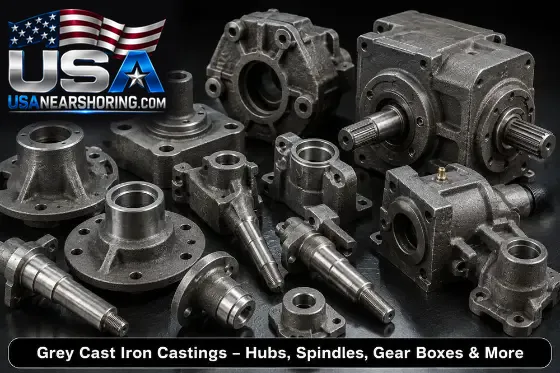
Grey cast iron castings: hubs, spindles, gear boxes

Castings

Gray and ductile iron, steel, aluminum and bronze. Sand, shell, investment, die and permanent mold.

Risk removed
Section 232 derivative duties on the full customs value, 10–16 week ocean pipelines, pattern and tooling stranded overseas.
How we move it
Mold-flow review, pattern transfer or rebuild, first-article and PPAP at the new foundry.
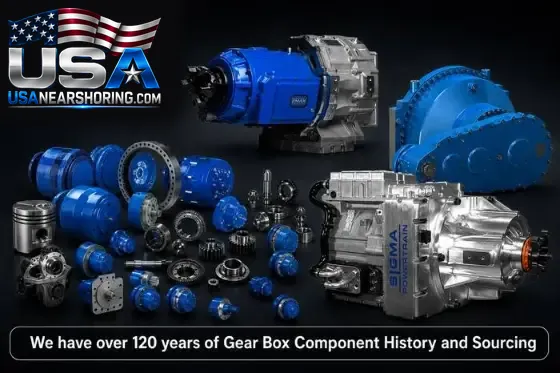
Gear box and power transmission components

Forgings

Closed die, open die and rolled rings from 1 inch to 18 feet in carbon, alloy and stainless steel.

Risk removed
Steel tariffs at the wholly-metal rate, heat-lot traceability gaps, long die lead times.
How we move it
Die design review, material certs to spec, heat-treat and NDT qualification close to your plant.
High precision machined spindles, splines and pistons

CNC machining

Turned and milled parts, 3- to 5-axis, prototype through production, with finishing and assembly.

Risk removed
Stacked country and metal duties, drawing-revision lag across time zones, costly air-freight expedites.
How we move it
VA/VE design review, gaging and inspection plans, capacity-matched Midwest machine shops.
Stainless steel fasteners with marine coatings

Specialty fasteners

Cold-headed specials, stainless and alloy bolts, studs, inserts and custom-thread parts.

Risk removed
Steel derivative duties, antidumping exposure on some origins, counterfeit and grade-marking risk.
How we move it
Consolidated part-number review, domestic headers and platers, certs and lot traceability to the box.
Plastic injection molded parts

Plastics

Injection molded, overmolded and insert-molded parts, from engineering resins to commodity grades.

Risk removed
Country tariffs of 10–12.5% plus legacy China duties, molds you can’t see or audit, resin-driven price swings.
How we move it
Mold transfer or rebuild, mold-flow analysis, resin sourcing strategy and color/texture approval.
Seat track parts, 2-way and 4-way

Seat tracks

2-way and 4-way seat track hardware and complete seat track assemblies: stampings, rails, latches and adjusters.

Risk removed
Steel derivative duties on stamped and welded content, long ocean pipelines for launch-critical parts, safety-critical quality escapes.
How we move it
Fixture and gage transfer, weld and stamping qualification, PPAP and run-at-rate before the offshore source stops.
Steering column assembly

Steering columns

Tilt and telescoping column assemblies, intermediate shafts, yokes, brackets and housings.

Risk removed
Stacked metal and country duties on machined and cast content, safety-critical traceability gaps, expedites that wipe out savings.
How we move it
Steering-column heritage from Douglas Autotech / JTEKT, functional and endurance test plans, APQP and PPAP at the domestic supplier.
Orthopedic surgical instruments

Orthopedics

Orthopedic surgical instruments, plastic trials, and knee and round broaches in stainless, titanium and medical-grade plastics.

Risk removed
Long offshore lead times on instrument sets, device-history and material traceability gaps, regulatory documentation risk.
How we move it
ISO 13485 suppliers, first-article and CMM reports, full lot and material traceability for your device history file.
Self-defense and firearm components

Personal protection

Machined and cast components for firearm, self-defense and personal protection products.

Risk removed
Export and import compliance exposure, finish and fit variation across lots, long lead times on launch quantities.
How we move it
Made-to-print domestic machining and casting, documented finish specs, and lot and material traceability on every shipment.

From risk audit to steady production

A controlled transition with no gap in supply. Your offshore source keeps shipping until the new supplier is approved.

  1. Fortune 100/500 vendors only

    We only use vendors that Fortune 100 and 500 corporations use, for lower risk.

  2. Risk audit

    Score every part on tariff, freight, currency, lead time and quality exposure.

  3. Landed-cost model

    Should-cost and full landed cost, offshore versus domestic, with tariff scenarios.

  4. Supplier qualification

    On-site audits, capacity checks and APQP planning with vetted U.S. suppliers.

  5. Tooling & PPAP 99% OTD and 99% PPAP 1st Time

    Transfer or build tooling, first article, PPAP and run-at-rate.

    Zoomed in below
  6. Launch & dual-source

    Ramp with safety stock and keep a second source where the risk warrants it.

Step 4, up close

Tooling & PPAP (99% OTD and 99% PPAP 1st Time)

Upon PO placement, before any production tooling is cut, we provide four engineering deliverables for your review. Example shown: an aluminum transmission housing casting.

A

Process flow

Every operation from raw material to pack-out, with inspection points and the rework path mapped before the first part is made.

  • Each operation and its sequence
  • Inspection and hold points
  • Rework / MRB path for nonconforming parts
Melt & pour Shakeout Heat treat Machine Inspect Pack-out Rework / MRB

B

Skeleton casting & parting line

The casting as-cast, the parting line between the cope and drag halves of the mold, and its orientation from the top view, so the pattern and tooling are right the first time.

  • Isometric view as cast
  • Parting line between mold halves
  • Parting line orientation, top view

C

Part holding & fixturing (datums)

Exactly how the casting is located and clamped for machining: Datum A primary 3-point support, Datum B side locate, Datum C end locate, and hydraulic top and side clamps.

  • Datum A: 3-point primary support
  • Datum B and C: side and end locates
  • Hydraulic vs. manual clamping

D

Complete gaging plan

Every critical feature and how we will gage it: go/no-go gages for bores, bolt-hole position, slots and boss heights, plus CMM inspection on the same 3-2-1 datum scheme.

  • Go/no-go gages for critical features
  • Pass / fail criteria for each gage
  • CMM setup on the same datums

Until you are satisfied, we don’t move off this step.

Your sign-off on all four deliverables is the gate to PPAP submission, run-at-rate and launch.

Toyota Processes embedded in all we do. American jobs, American suppliers, American-made parts.

You get the best of both worlds, but America gets the parts, the revenue, and takes care of its own.

Bring it home. Send us your most costly, highest quality-problem part numbers.

Share a parts list or a few drawings. We’ll return a risk score, a landed-cost comparison and a short list of parts worth insourcing first. Give us your biggest problems, we will fix them.

Call Michael Musleh

USA Near Shoring, Auburn, Indiana